The students, I was teaching at the time, were very excited about Japanese AnimĂ©. So the content of the book fit the kids’ interests. I had the idea to take an unfinished stool and add a Super Flat-like painting to it. Although I wasn’t successful in getting the students to paint their own stools, they liked seeing me paint my design.
Saturday, January 23, 2010
Super Flat Stool
Some years ago while browsing the Art section of Barnes and Nobles, I happened upon a book called The Japanese Experience: Inevitable. The book featured the work of a group of artists that call their art “Super Flat.” It is a Japanese Pop Art movement. I bought the book, which traces the art movement’s history to earlier Japanese art – sometimes described as a “floating world.”
The students, I was teaching at the time, were very excited about Japanese AnimĂ©. So the content of the book fit the kids’ interests. I had the idea to take an unfinished stool and add a Super Flat-like painting to it. Although I wasn’t successful in getting the students to paint their own stools, they liked seeing me paint my design.

The students, I was teaching at the time, were very excited about Japanese AnimĂ©. So the content of the book fit the kids’ interests. I had the idea to take an unfinished stool and add a Super Flat-like painting to it. Although I wasn’t successful in getting the students to paint their own stools, they liked seeing me paint my design.
Friday, December 11, 2009
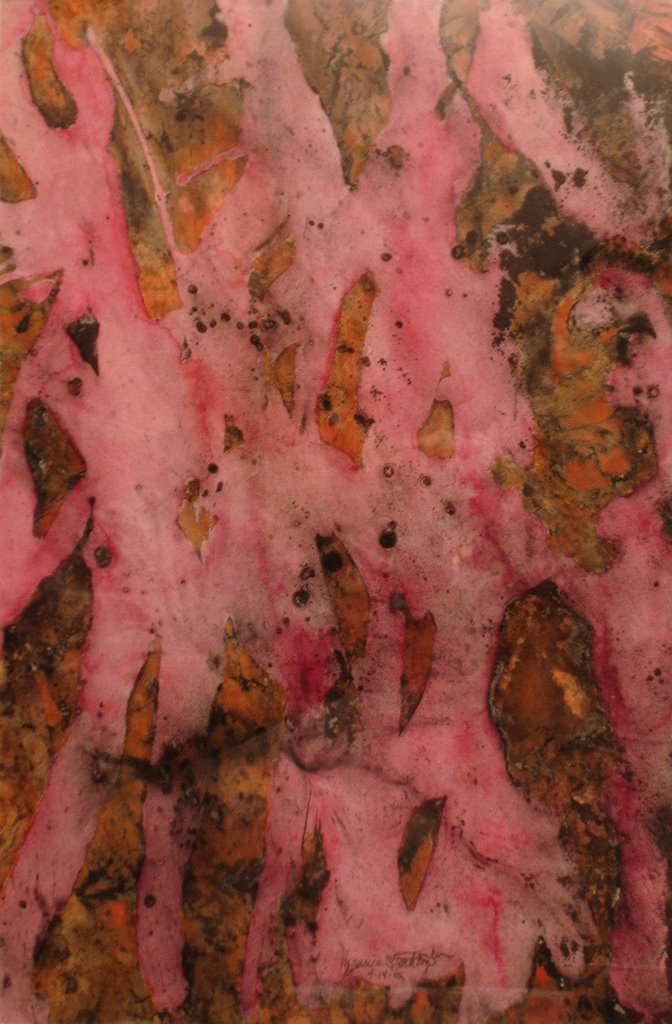
Premonition Pink
Saturday, November 07, 2009
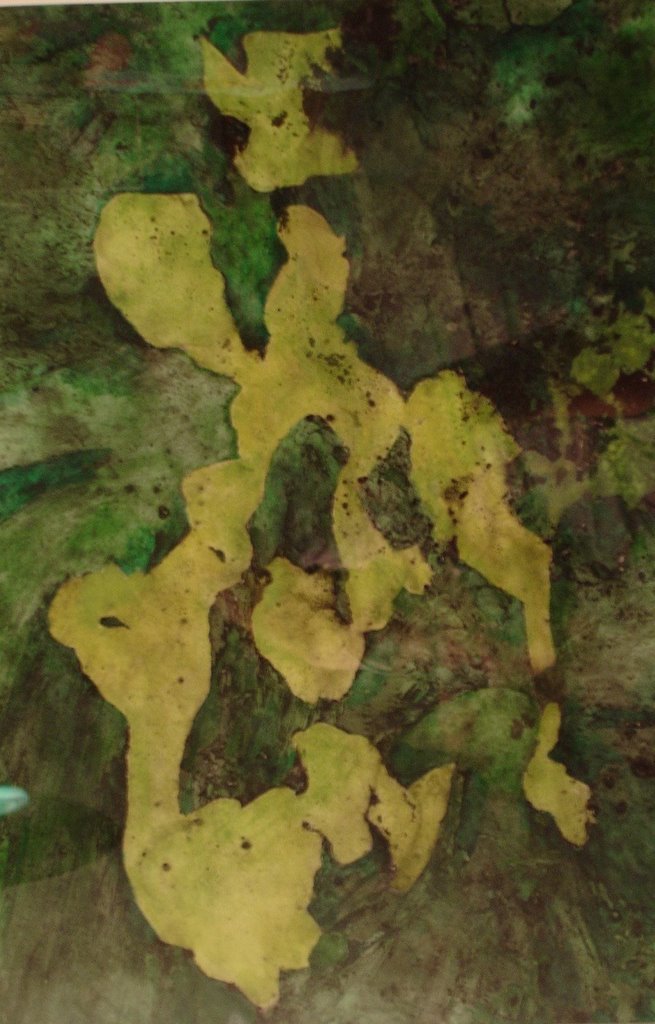
Premonition Green
Wednesday, October 21, 2009
Premonition Orange
Some years back I'd seen a technique demonstrated involving charcoal dust. Water is applied with a brush to areas that are to remain whitest. Charcoal dust is then sprinkled across the page. Then a bucket of water is splashed across the page. The dust sticks to the areas that were dry. This process is best done outside because of the mess involved.
Afterwards I used spray fixative to keep the dust on the paper. On top of the dust I painted watercolors. I was pleased with the result.
This is the first one I did for my students to show them what was possible. Folks have told me it looks like a map. I simply painted complementary colors.

mixed media on paper, 17.5" x 24"
Monday, September 14, 2009
120 Colors
During the spring testing of 2005 I drew this piece beginning with a grid. Using Prismacolor Sticks, I drew expressive lines across my grid. Then I added circles inside each box. I proceeded to blindly pick six colors at random as I filled in each box and the circles within. Filling out testing forms had inspired this part of my piece.

colored pencil on paper, 21" x 26.5"
After I rendering with the six colors, I again chose six random colors. When I reached the last of the 120 colors, I put the rest back in the box and picked at random again. This went on until I completed the piece.
From the outset I was determined to use all 120 colors that came in the Prismacolor box. So often artists are advised to only use a limited palette. Anyway it took a while to finish this drawing.
Sunday, August 02, 2009
Tuesday, July 28, 2009
Sunday, June 14, 2009
Red Rock
Monday, May 11, 2009
Artroom
In college when I took the course Freehand II, there was a project we did that involved charcoal rubbings on tracing paper collaged with colored inks. Later on when I was teaching, I thought I’d experiment with the same method. I already had those supplies and I wanted to convince my students to work with mixed media. So I created this piece as a sample. Usually if the students saw me enjoy making a piece first it was an easier sales job to convince them.

mixed media, 11" x 15"
This time I used rice paper to make charcoal rubbings from objects and surfaces around the artroom. I then painted matte acrylic polymer to adhere the rubbings to watercolor paper. After the rubbings were dry, I spray fixed them. I then painted layers of color inks on top of them.
While digging through some boxes I found this piece. I think I will try to do some more works using these materials. It’s a direction that I really had not pursued.
Tuesday, April 21, 2009
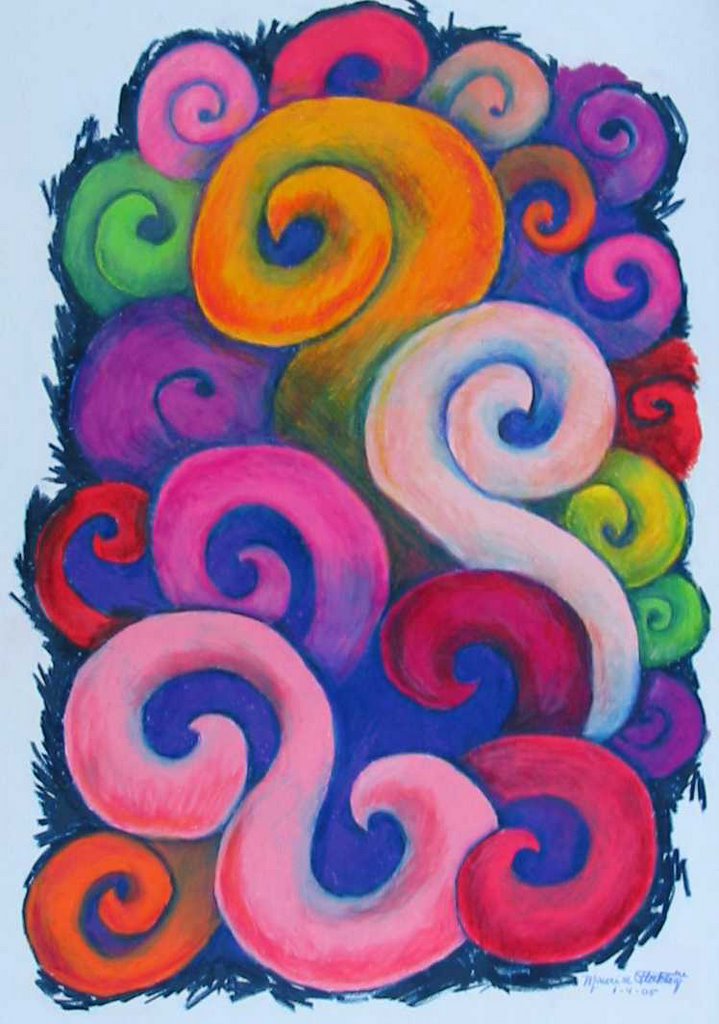
Curls Gone Wild
Saturday, March 14, 2009
Sunday, February 22, 2009
Afire
Friday, September 26, 2008
Purple Blend
Do you ever read the Sunday comics in full color? Did you realize you’re looking at pieces of the Sunday comics right now?
This collage is made up of pieces of the Sunday comics collected between September 2004 and March 2007. The only thing that they have in common are the colors. Speedball acrylic gloss is used to glue them down on Reeves BFK paper. I recently took a break from my dot artwork to complete this piece.

collage, 10.5" x 19"
So what made me create this work?
Well back in the summer of 1998 I took a trip to Chicago and saw the work of Ray Yoshida. He taught at the School of Art at the Institute of Chicago. I enjoyed the show so much I bought a catalog.
It wasn't until seven years later in March of 2005 that I got around to doing a piece in the spirit of the work I saw in Chicago. Cutting out the pieces from the Sunday funnies was very time consuming. I wanted my students to see how the context of the comics could be changed in a collage. It was a good way to show them how to use found materials.
Saturday, August 16, 2008
We See
The materials for this collage were handed to me at a lecture on Hannah Hoch in Boston. It was one of many seminars I attended at a national art teachers convention in March 2005. The speaker asked 25 of us to make a collage out of the materials she put in a cellophane bag. She referred to it as a "Dada bag." When I returned home, I worked on this piece as an example for my talent art students. I wanted them to see how unusual materials could be used to make a collage.

collage, 17.5" x 24"

collage, 17.5" x 24"
Subscribe to:
Posts (Atom)